
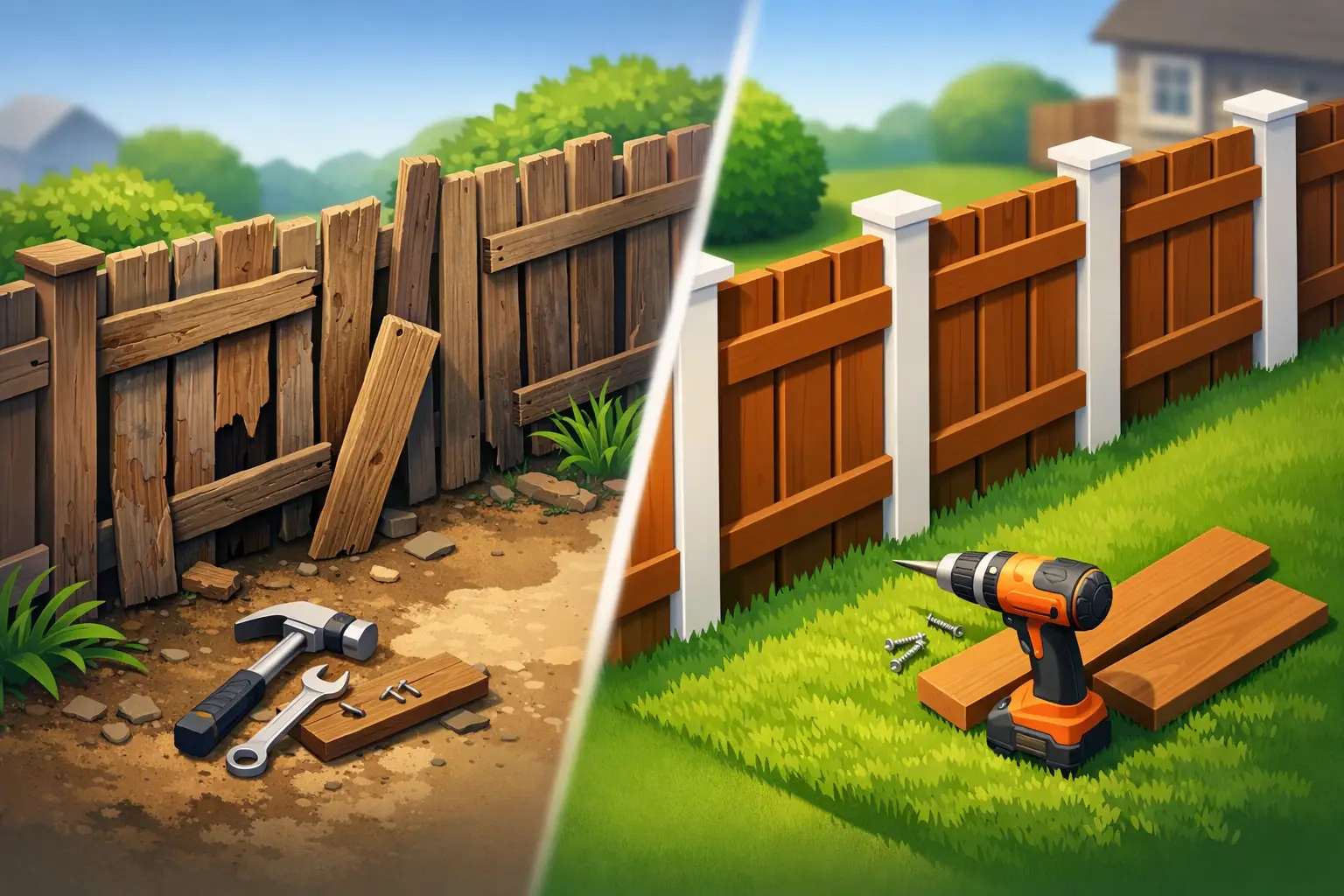
A fence usually tells you the truth before it fully fails. Maybe the gate drags, a few pickets lean after a storm, or one section looks fine while the next is soft, cracked, or pulling away from the posts. If you are asking, should I repair or replace fence, the right answer depends on how much of the structure is still sound and whether a repair will actually hold up.
For Oklahoma City homeowners, that decision often comes down to more than appearance. Wind, shifting soil, moisture, tree roots, and age can all shorten a fence’s lifespan. A quick repair can be the smart move in some cases, but patching the wrong fence usually leads to more service calls, more cost, and more frustration a few months later.
Should I repair or replace fence if only part is damaged?
If the damage is isolated and the rest of the fence is still structurally solid, repair is often the better value. A few broken pickets, one damaged rail, a sagging gate, or even a small section knocked loose by weather can usually be fixed without tearing out the whole line.
The key question is whether the problem is cosmetic, local, or systemic. Cosmetic issues include faded stain, surface wear, or a couple of cracked boards. Local problems include one leaning panel or one or two weakened posts. Systemic problems show up when multiple sections are leaning, posts are loose across the property, rot is spreading, or the fence no longer has consistent strength from one end to the other.
A repair makes sense when the surrounding material is still doing its job. If the crew can replace the failed section and tie it into a solid structure, you are extending the life of the fence. If the nearby posts, rails, and boards are already near the end, a repair can become temporary at best.
When fence repair is the right call
A good repair can buy years of useful life when the fence still has a strong foundation. That usually means the posts are set well, the rails are mostly intact, and the damage is limited to a manageable area.
Wood fences often qualify for repair if the issue is one section with rot near the bottom, several storm-damaged pickets, or a gate that has shifted out of alignment. Chain link can often be repaired when the fabric is bent in one area or a top rail has been damaged. Even metal fencing may be fixable if the problem is limited to one panel or connection point.
Repair is also a smart option when you want to preserve a fence that still matches the rest of the property. If the structure has several good years left, replacing a few parts is usually more practical than starting over.
There is one trade-off, though. Repairs on older fences may not match perfectly. Wood weathers differently over time, and new sections can stand out until they age. For many homeowners, that is an easy compromise if the fence is safe and solid again.
Signs a repair will likely hold up
If you can point to one or two clear trouble spots and the rest of the fence looks straight, stable, and dry, that is a good sign. Posts should feel firm, not loose at the base. Rails should be attached securely. Boards should not crumble, split deeply, or pull free with light pressure.
A repair also holds up better when the original installation was done correctly. Good post depth, proper spacing, and clean alignment matter. A well-built fence with isolated damage is worth saving.
When replacement is the better investment
Replacement becomes the better decision when the fence is failing in multiple places or the core structure is compromised. That includes widespread rot, repeated leaning, broken or shifting posts, and major storm damage that affects long runs instead of one section.
If you are making the same repair more than once, that is usually a warning sign. One repaired gate can be normal maintenance. A repaired gate, plus loose posts, plus cracking rails, plus warped panels often means the fence is simply wearing out.
Age matters too. Most fences do not fail all at once. They decline a little at a time, and homeowners get used to working around the problems. Then a storm hits, a gate comes off, or a section drops enough to create a security or safety issue. At that stage, replacement is often more cost-effective than trying to stabilize a fence that has reached the end of its service life.
Safety should make the decision easier
A damaged fence is not just a curb appeal issue. Leaning sections can fall. Loose gates can swing unexpectedly. Rotten posts may not hold during strong Oklahoma winds. If the fence surrounds children, pets, a pool area, or a shared property line, stability matters more than squeezing a little more time out of old material.
For homeowners dealing with nearby trees, roots and falling limbs can also affect the decision. Sometimes the fence is repairable, but the cause of the damage is still present. In that situation, replacing or repairing the fence without addressing the tree issue can lead right back to the same problem.
Cost is important, but so is value
Most homeowners start with price, and that makes sense. Repair is usually cheaper up front than replacement. But the lower price only works in your favor if the repair lasts.
If a repair solves the issue for several years, that is money well spent. If it only delays a full replacement by a few months, the lower upfront cost can turn into a higher total cost. You pay once for the patch, then again for removal and replacement.
That is why the better question is not only what costs less today. It is which option gives you a safer, longer-lasting result without repeated problems. A dependable contractor should be honest about that difference. Sometimes the answer is a straightforward repair. Other times the right call is to stop putting money into an aging fence.
Should I repair or replace fence after storm damage?
Storm damage is one of the most common reasons homeowners face this decision. Wind can snap pickets, rack entire panels out of square, loosen posts, or bring down sections after a tree limb falls across the fence.
If the storm damage is limited to one area and the posts remained solid, repair is often enough. But if wind exposed weaknesses across the fence line, replacement may make more sense. Storms tend to reveal existing age and installation issues. What looks like one damaged section may actually be part of a larger failure.
This is where an on-site inspection matters. It is hard to judge structural condition from a distance, especially when the visible damage is only part of the problem. A fence can still be standing and already be unstable.
Matching materials and neighborhood standards
Another factor is how well a repair can blend with the rest of the property. In some neighborhoods, appearance matters almost as much as function. If your fence is front-facing, highly visible, or part of a shared line, patching several mismatched sections may not give you the result you want.
Replacement may also be the better option if you want to upgrade materials, improve privacy, or correct an older layout that no longer works well for your yard. If you were already considering a style change, a major repair bill can be the point where replacement makes more sense.
For property owners who care about a clean, finished look, there is value in having a fence that is straight, consistent, and built to last. That is especially true when you are preparing to sell, dealing with repeated repairs, or trying to improve overall curb appeal.
What homeowners in Oklahoma City should look for
In this area, wind exposure, moisture, and shifting ground can all shorten the life of a fence. If you notice leaning posts, soft wood at the base, fasteners pulling loose, or gate hardware struggling to hold alignment, do not wait too long to have it checked. Small issues become large ones quickly when weather gets involved.
A good estimate should tell you more than a number. It should explain what failed, what is still solid, and whether a repair is likely to last. That kind of straight answer saves time and helps you make a decision with confidence.
At Fowler’s Tree & Fence, that practical approach matters. Homeowners want clear recommendations, safe work, and a clean jobsite when the work is done. Whether the right fix is a targeted repair or a full replacement, the goal should be the same – get the fence stable, secure, and done right the first time.
If your fence has started leaning, sagging, or showing its age, the smartest next step is not guessing from the driveway. Have it looked at before a small problem turns into a bigger one.


0 Comments